





















Carry-and-Familiarity
By George Devinny. Aug 11, 2026
This is a very broad subject but here it is intended to just briefly concentrate for the most part on gun matters, in particular on guns used for carry. Beyond that though also a brief mention of familiarity with laws and also general people assessments.
If you are one of many who has decided to carry, particularly more recently, then it is considered essential that familiarity with your particular piece is at the very least adequate, if not closer to expert - much of which is down to ''muscle memory''. A lot of people decide to carry and then pick a gun from any one of many they may own, or in a worst case, go round to a local gun shop and purchase something to put into use immediately.
Most folks are probably tired of hearing ''advise" on what type of gun to choose and the intention is not to go that route, rather just trying to remind about the actual familiarity factor. The reason for making the point is simply that should there be a need to have to ever use your piece in anger, when all other options are played out, then the implement must come to hand with absolute confidence.
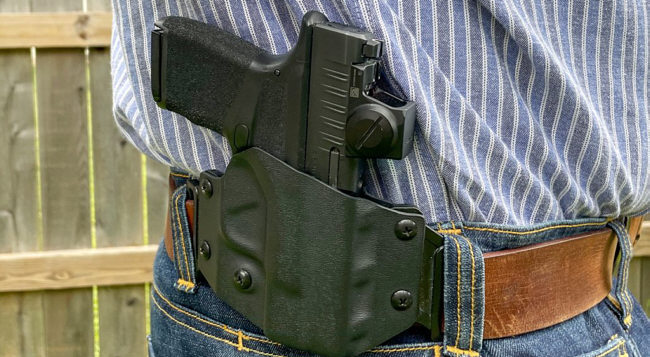
Training: this is indeed very valuable, if not ideally essential and geared to a specific gun - not just when it comes to accuracy but more important even, with fluency. There are many levels of training of course but for the purposes of this discussion we can mainly suggest just the basic matters comprising weapon familiarity with handling as well as breakdown, cleaning, clearing a jam and even choice of holster/carry method. The latter is a subject in itself but suffice to say, attention must be given to holster style, ergonomics and actual dress choices.
Mechanical familiarity: the bulk of the information required should be available within the firearm's user manual - involving for the most part proceedures needed for any routine disassembly and cleaning. With a revolver of course there is not much to be dealt with in terms of break down, other than maybe knowing how to removed a cylinder and crane for occasional deep cleaning - most of the time cleaning can be done of barrel and cylinder without taking anything to pieces. A semi-auto is however a different matter and there's a need to know the specific field strip method and sequence. For the most part trigger groups probably don't required major break down, compressed air often being enough for cleaning. In passing - do not over oil your firearm.!
Mechanical fluency: Perhaps the most important aspect when it comes to safety and survivability. When a gun is drawn it MUST feel totally comfortable in the hand, with controls being instinctively available such as a safety lever, magazine release and even the 'feel' in the hand which will be a function of the grip profile. These factors are best mastered simply by practice and that can to a large extent be achieved through safe 'dry fire', including draw too, although live fire practice is also needed - in particular regarding recoil control. The whole objective is to feel that the firearm when being handled is part of the hand and arm such that it feels natural and requires no extra input of mental effort to operate, including a reload..
It can be a salutary lesson to sample someone else's unfamiliar carry piece on the range and see how well it can be handled regarding comfort as well as accuracy - not forgetting a trial reload as well - results can be surprising sometimes. It is often the smaller things that require most attention which can include anything from sights usage (iron and or optics), location and use of mag release if a semi, and of particular importance, the grip and hand fit. All should feel second nature.
We have only skimmed the guns aspect very broadly but can only encourage all those who carry or intend to carry to treat the process as always something with which to maintain the utmost responsibility and strive for safety and skill. (We have not mentioned the use of optics which is itself a large subject but, suffice to say - if optics used then they must be fully understood functionally - plus action needed when battery fails!)
The law: This should almost go without saying in order to stay on the right side of the law when carrying - not in fact the easiest job, but essential in order to stay the free person you should be The intention here is not to go through laws as much as encourage everyone to not only check their local state laws and ordinances but, know what is further afield if likely to be carrying out of state. Unfortunately, the law is a mineflield depending very much on where you reside but being aware is entirely a 'CYA' deal, in particular the ''where'' factors including the obvious such as federal, schools etc, beyond which will be the legally absurd. Carry a firearm is a huge responsibility.
People: This is a huge subject potentially but seeing as I am not a professional psychiatrist there is no wish to try and pontificate over the many broad and sometimes subtle fine details. Suffice to say, we should be able to learn and study people, being able able to at least to some degree assess their character type most notably when it comes to threat assessment. Reference is often made to ''spidey sense'' with behaviors of others and is not something to be down played if looking to assess any threat. One thing often mentioned is that appearance just on its own is often no guide as to the nature of an individual - somewhat akin to the best "con'' man often seeming the most natural and normal instead of displaying any overtly suspicious characteristics.
Appearance may be one feature but perhaps the most important of all is perceived behavior, with many signs being important to observe and assess. In fact not infrequently it can be the most subtle of an individual's actions that can be a giveaway as to what may be happening next - an assessment of intention where something does not feel right. Fortunately there are more good people than bad but learning to 'read' the intentions of others makes for a significant means of being forewarned of something potentially problematic.
This has not been an attempt to ''preach to the choir'', as many people who carry are already experienced and practiced but there are also those who are still newer to carrying and even many who can simply benefit from reminders and avoid the onset of complacency. No one wishes to ever have to use the final sanction for many reasons - all the better to be practiced at environmental awareness along with firearm familiarity.